This digital presentation and its accompanying notes are a professional learning resource for K–12 educators titled “Honoring Our Shared Humanity: Understanding and Addressing Islamophobia and Anti-Arab Bias in Our Schools.”
The presentation introduces the diversity of Muslim and Arab communities, defines Islamophobia, anti-Arab bias, and anti-Palestinian bias, and traces the historical roots of today’s stereotypes and how they show up in school settings. It then offers practical strategies educators can use to support their students, including inclusive language, accommodations for religious practice, notes for interrupting bias in the moment, and guidance on when and how to report incidents. It is accompanied by an Educator Response Scripts for Everyday Moments, which educators are welcome to download, print, and share with colleagues. The cheat sheet gathers ready-to-use language for interrupting biased comments, supporting a student who has been targeted, and addressing the class after a difficult world event. You can access and download it here.
To go deeper, ING offers educator trainings and speakers bureau presentations for schools and community groups, including inclusion training for K–12 educators and sessions on combating Islamophobia. Please visit this page to schedule a training or speaker for your school.
This presentation is the intellectual property of Intercultural Networks Group (ING) and is protected by copyright. It is made available for non-commercial public reference. Any use of its content must be for educational purposes only and must include proper attribution following standard citation guidelines. This presentation and its contents may not be displayed or distributed in exchange for payment in cash or in kind.
Sign up below to receive detailed notes for this presentation.
Countering Islamophobia in Education
Introduction
Islamophobia and anti-Arab bias are among the most widespread and least discussed forms of bigotry in American schools. In school-climate surveys, roughly half of Muslim students report being bullied or mocked because of their faith, and harassment of Muslim, Arab, and Sikh students spikes sharply after world events. These biases rest on stereotypes that are centuries old, recycled through media and conflict after conflict, and absorbed by young people long before anyone teaches them directly.
Schools are where those stereotypes can be interrupted. Teachers and school staff are the single biggest influence on whether targeted students feel they belong, which is why ING created this presentation. The slides move from understanding to action: who Muslims and Arabs actually are, what the bias claims and where it comes from, how it shows up in grades 7–12, and four concrete strategies every educator can use, from inclusive language and support for religious practice to interrupting bias in the moment and knowing when to report and refer.
The pages that follow explain each slide as it appears in the presentation.
The Presentation, Slide by Slide
Slide 1 — Title: Honoring Our Shared Humanity
Welcome, and thank you for viewing this presentation. Honoring Our Shared Humanity was created by ING for K–12 educators. In the slides that follow, we look at what Islamophobia and anti-Arab bias are, where they come from, how they show up in schools, and, most importantly, what educators can say and do about them. This presentation is not about politics, and it is not about blame. It is about one simple commitment: every student deserves to feel safe, respected, and known.
Slide 2 — Why This Matters in K–12 Schools
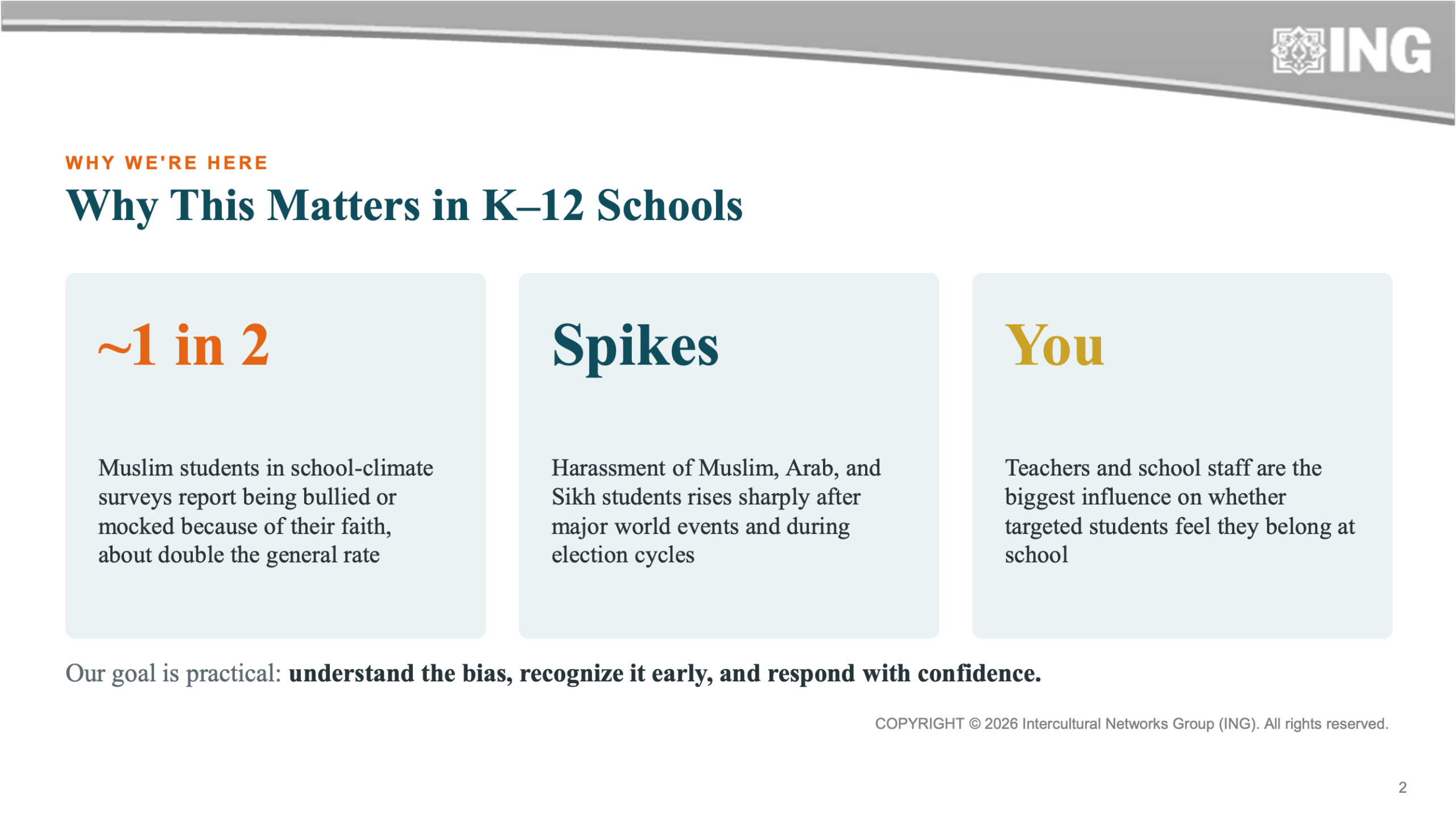
This slide shows why the topic belongs in every school. In school-climate surveys, roughly half of Muslim students report being bullied or mocked because of their faith, about double the general bullying rate. That harassment is not steady; it spikes after world events and during election seasons, and it also reaches students who are not Muslim at all, such as Sikh students who are perceived to be. The third card carries the good news: research and student voices agree that teachers and school staff are the single biggest influence on whether targeted students feel they belong. The goal of this presentation is practical: to help you understand the bias, recognize it early, and respond with confidence.
Slide 3 — Who Are Muslims?
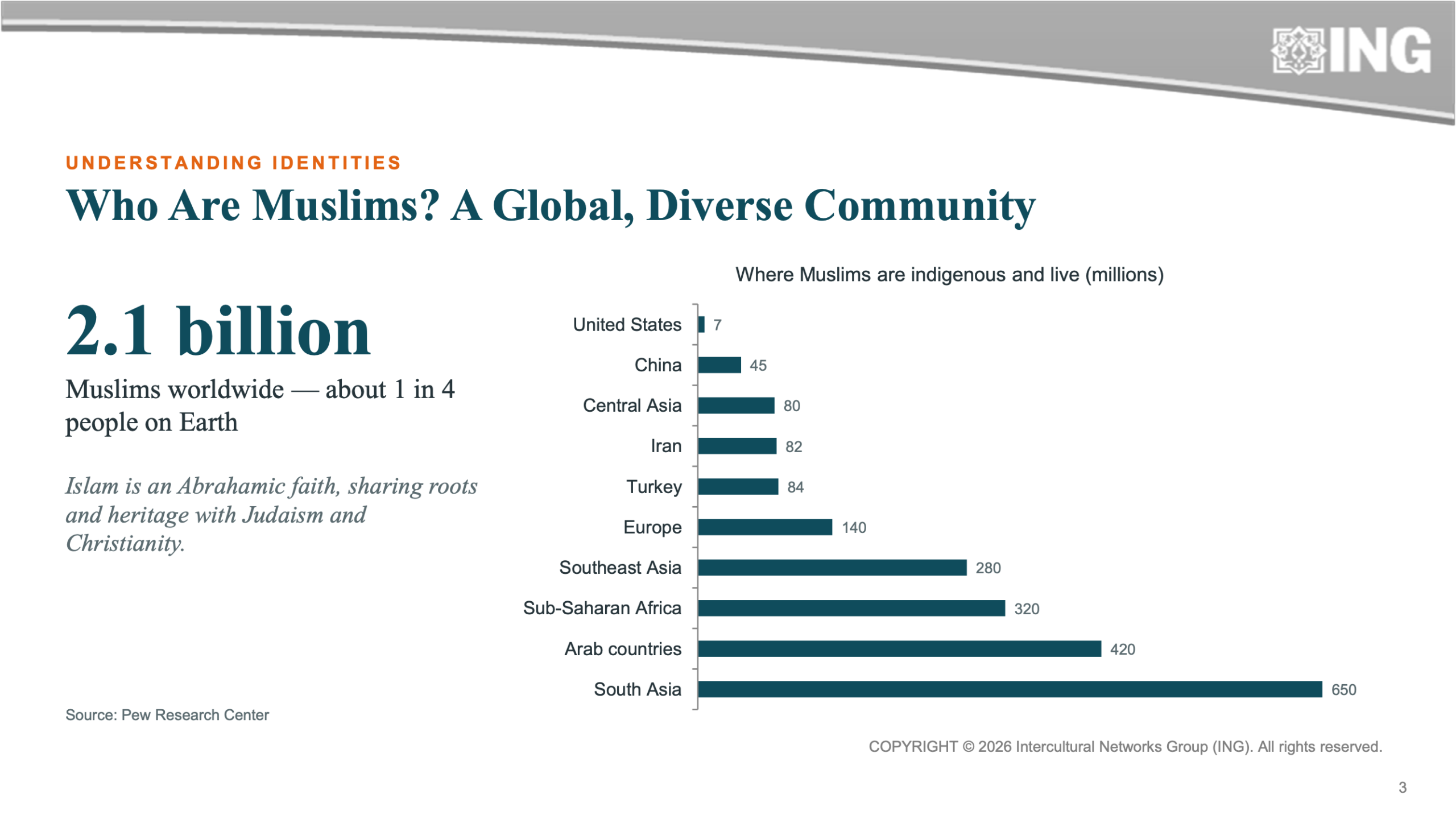
We begin with some grounding. There are about 2.1 billion Muslims in the world, roughly one in four people. The chart shows where they live: the largest populations are in South Asia, in countries like Indonesia, Pakistan, India, and Bangladesh, rather than the Middle East. Only about a fifth of the world’s Muslims live in Arab countries. Islam is also an Abrahamic faith, sharing roots and heritage with Judaism and Christianity. The first stereotype this slide asks us to let go of is the mental image that Muslims are from a single place or are a single kind of person.
Slide 4 — Muslim Americans
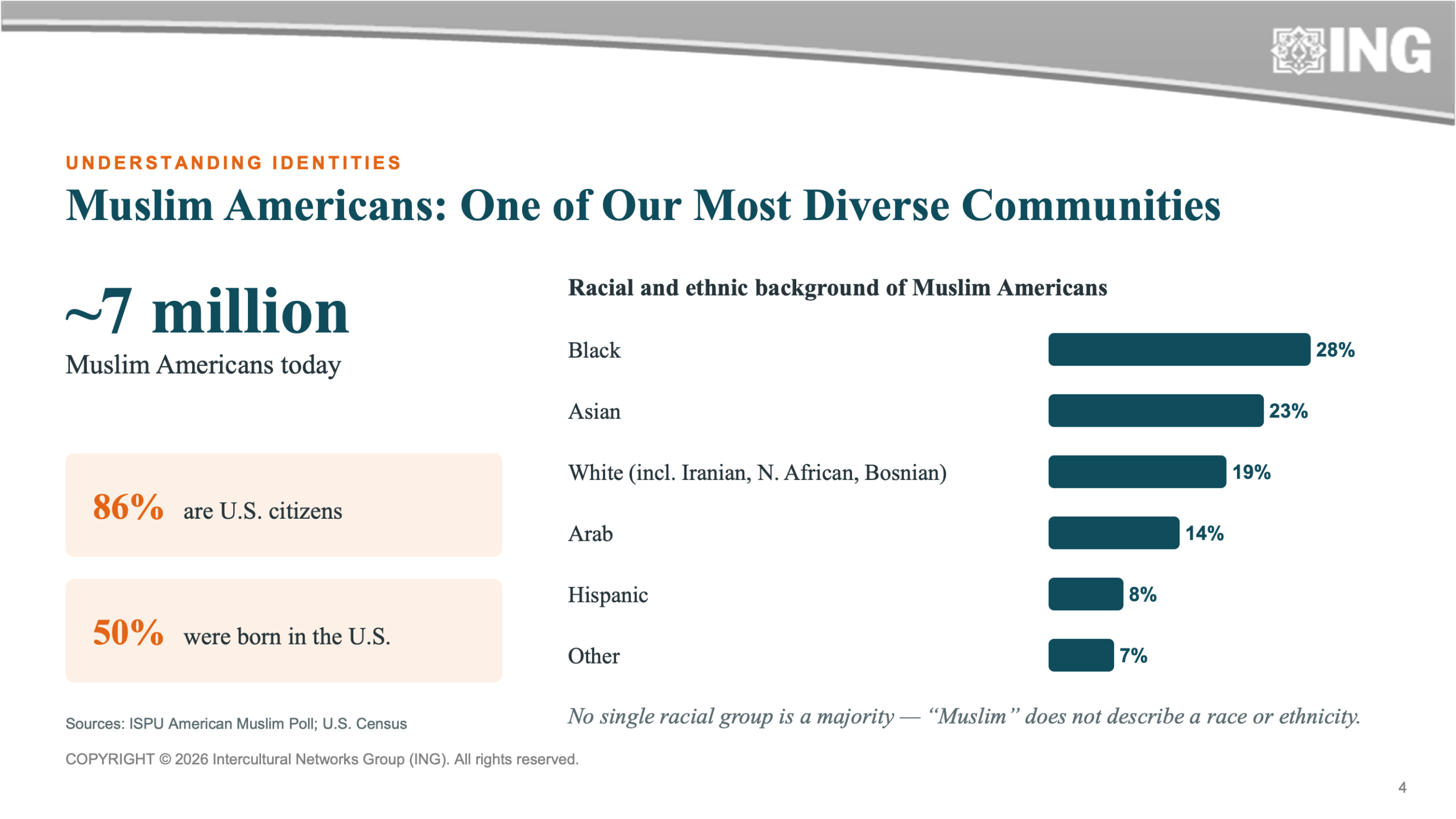
Closer to home, there are about seven million Muslim Americans, and they form one of the most racially diverse faith communities in the country. As the chart shows, more than a quarter are Black, about a quarter are Asian American, and no single group is a majority, because ‘Muslim’ is not a race or an ethnicity. Notice the two numbers on the left: 86 percent of Muslim Americans are U.S. citizens, and half were born in the United States. Muslim students should not be pictured as foreigners or newcomers; most are as American as any other student in the hallway.
Slide 5 — Who Are Arabs?
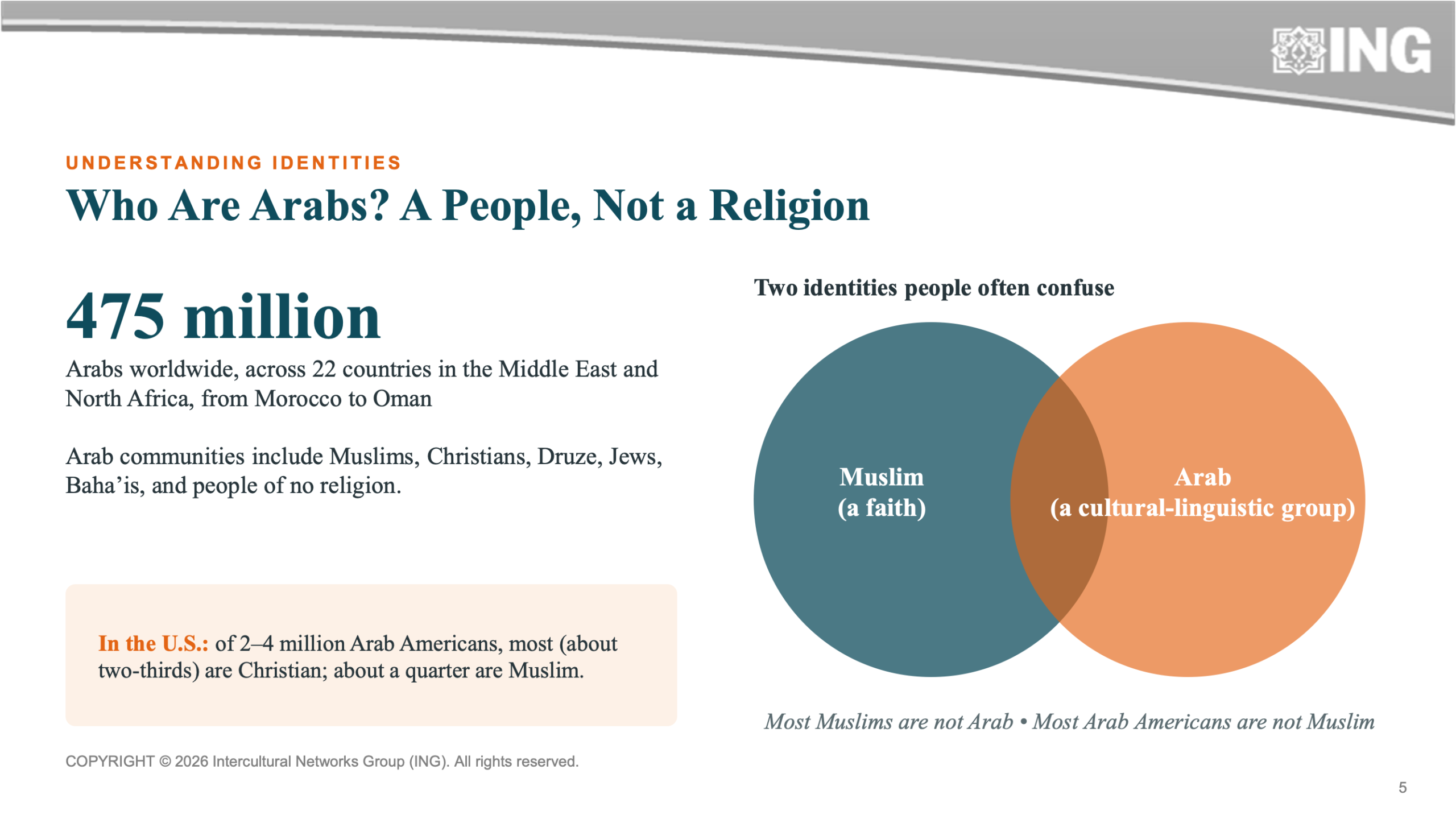
This slide turns to the other identity in the presentation’s title. Arabs are a cultural and linguistic group of about 475 million people across 22 countries, from Morocco to Oman. Arab communities include Muslims, Christians, Druze, Jews, Baha’is, and people of no religion at all. In the United States, most Arab Americans, roughly two-thirds, are Christian. The diagram on the right captures the key distinction: Muslim is a faith, and Arab is a cultural-linguistic group. Most Muslims are not Arab, and most Arab Americans are not Muslim. Bias, unfortunately, does not make that distinction, which is why this presentation addresses both together.
Slide 6 — Understanding the Terms
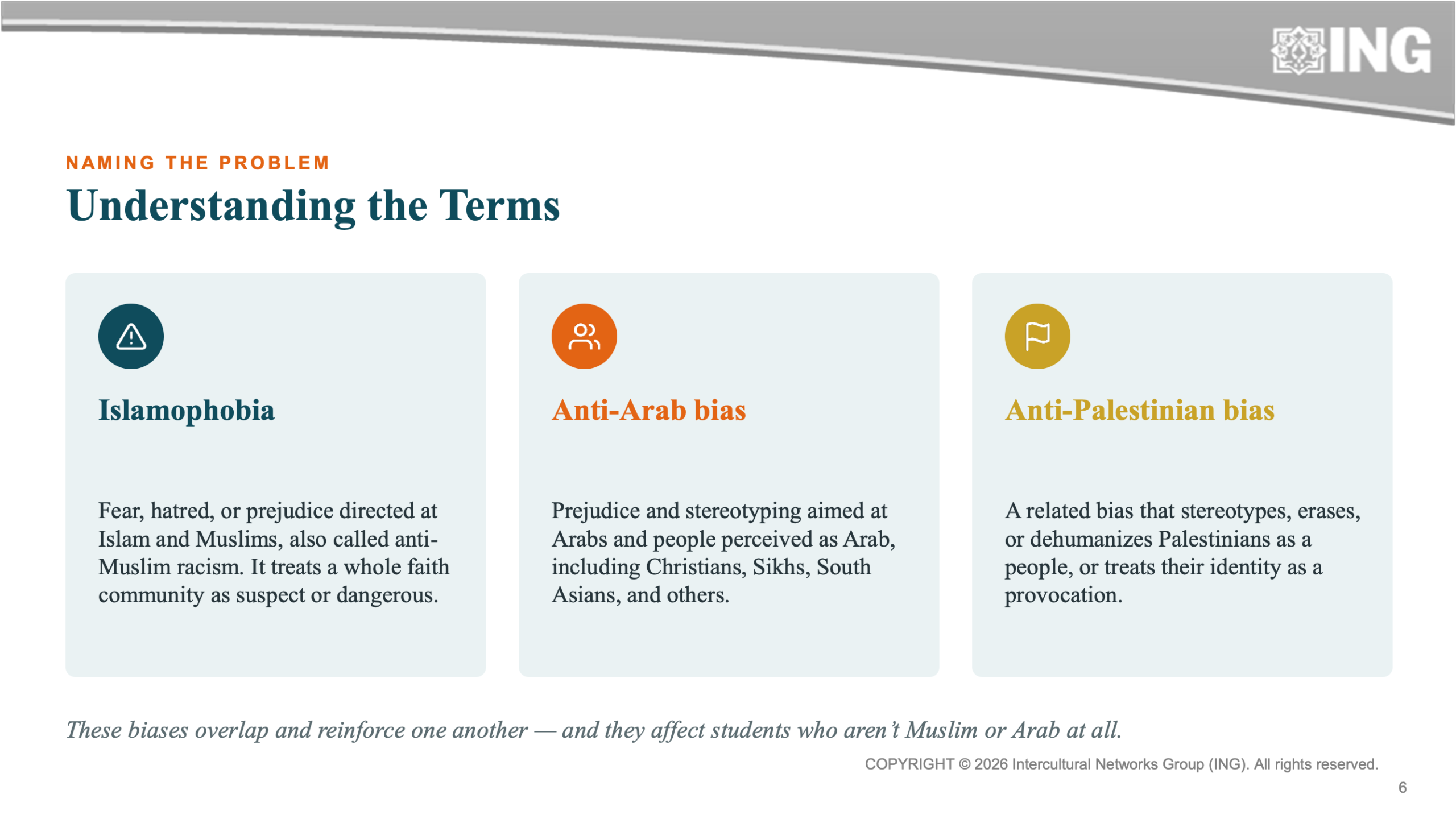
Here we define the terms used throughout the presentation. Islamophobia is fear, hatred, or prejudice directed at Islam and Muslims; many scholars call it anti-Muslim racism, because it treats a whole faith community as suspect or dangerous. Anti-Arab bias targets Arabs and anyone perceived to be Arab, which is how Sikh, South Asian, and Latino students end up harmed as well. Anti-Palestinian bias is a related form that stereotypes or erases Palestinians as a distinct people. These three biases overlap and feed one another. The practical point for schools: this is not a niche issue affecting only one group of students.
Slide 7 — Three Persistent Islamophobic Stereotypes
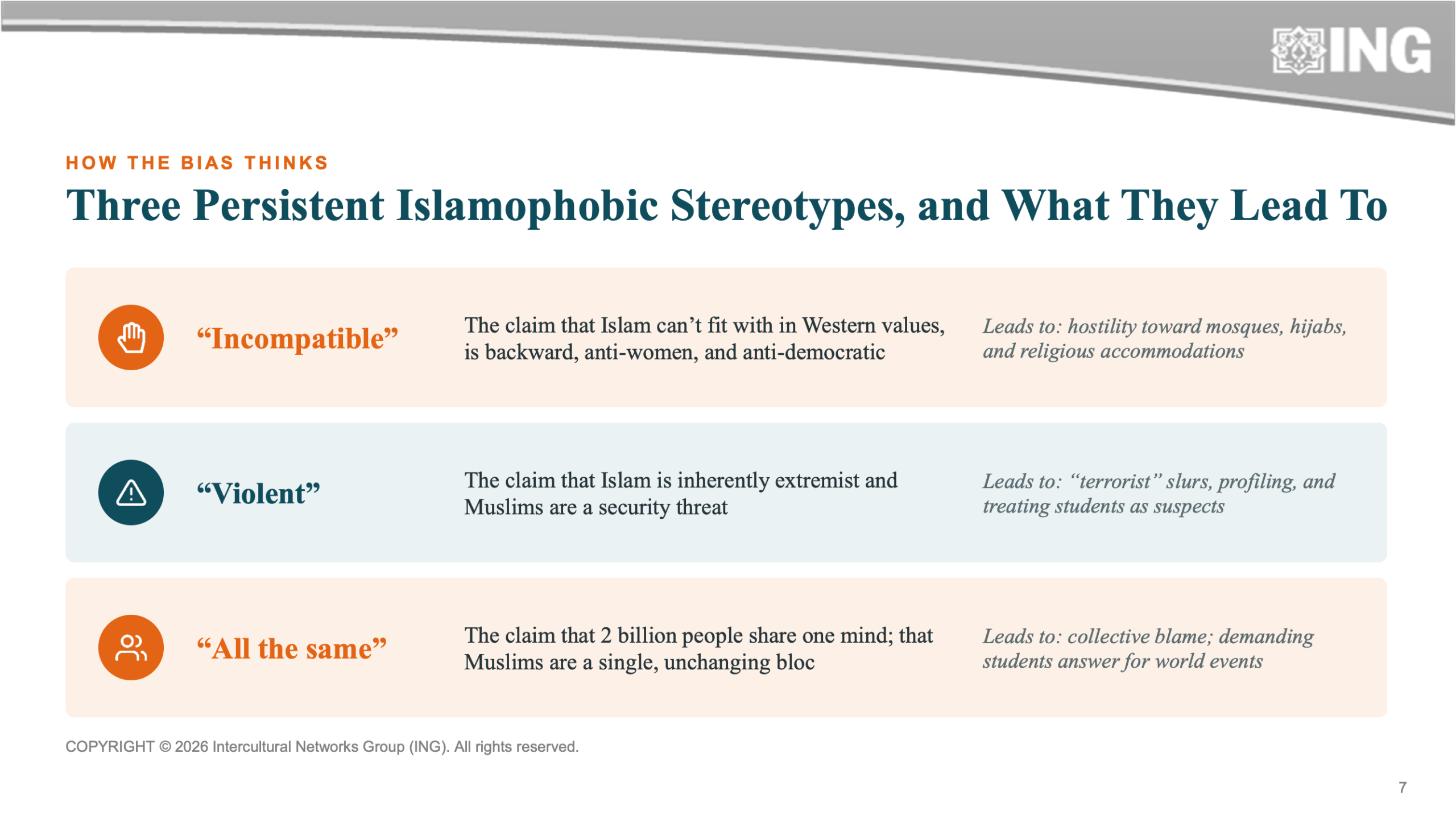
Almost every biased comment heard in a school traces back to one of the three stereotypes on this slide. The first is the claim that Islam is incompatible with Western or American values: backward, anti-women, and anti-democratic. That belief fuels hostility toward hijabs, holidays, and religious accommodations. The second is the claim that Islam is inherently violent, the source of ‘terrorist’ slurs and of treating students as suspects. The third is the claim that all Muslims, two billion people, are the same and share one mind. That is what leads people to demand that a fourteen-year-old answer for world events. Naming the stereotype behind a comment makes it far easier to respond to it clearly and calmly.
Slide 8 — Deep Roots
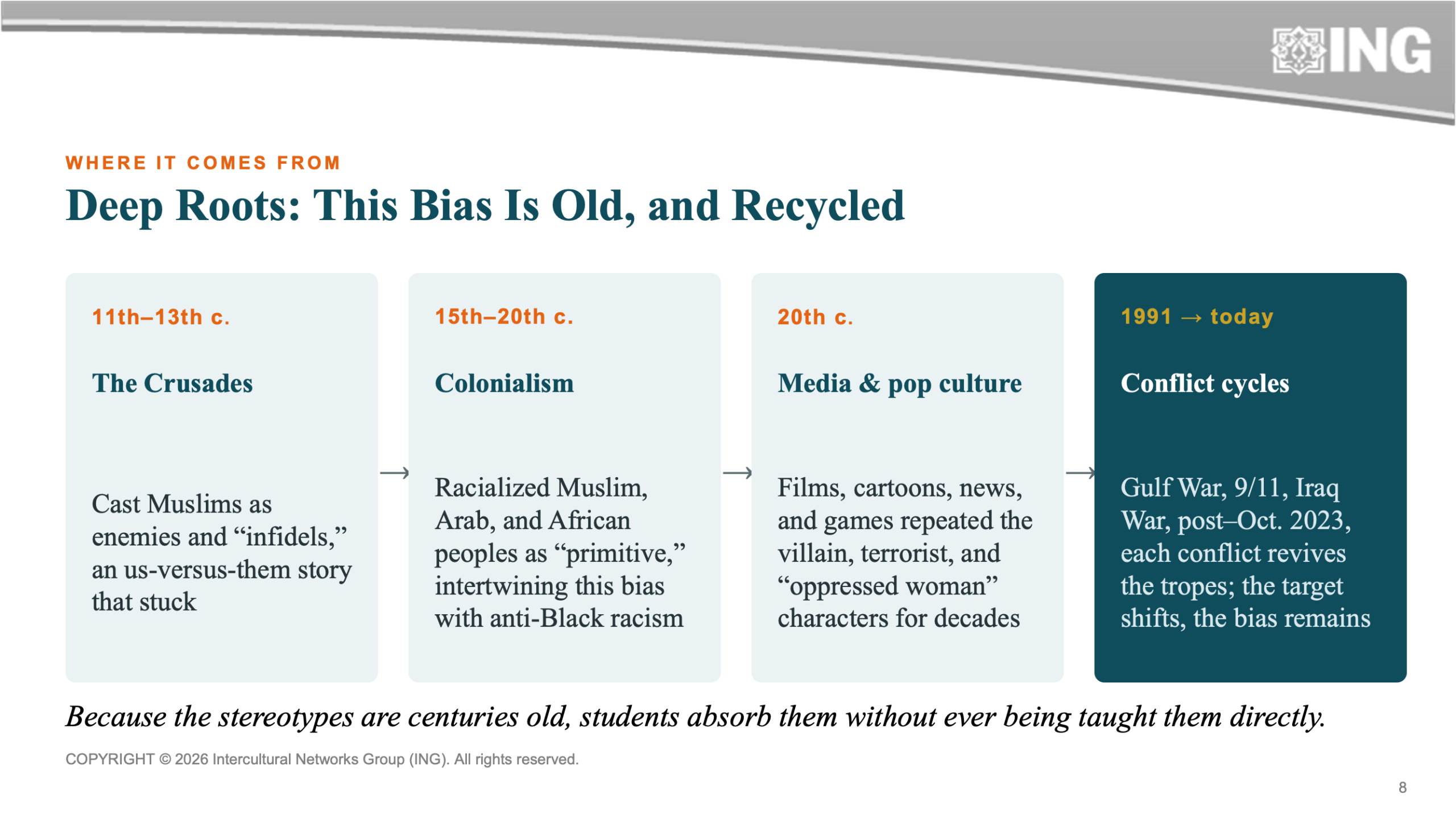
This slide traces where the bias comes from, and why it keeps returning. The Crusades cast Muslims as enemies nearly a thousand years ago. Colonialism racialized Muslim, Arab, and African peoples as primitive and ‘in need of civilizing,’ which is why this bias is intertwined with anti-Black racism. A century of movies, cartoons, news coverage, and video games then repeated the same stock characters. And each modern conflict, from the Gulf War and 9/11 to the Iraq War and the violence since October 2023, revives the same tropes. The target shifts; the bias remains. The takeaway for educators is at the bottom of the slide: students absorb these stereotypes from the culture without anyone teaching them directly, which means school is exactly the place where they can be interrupted.
Slide 9 — How Bias Shows Up in Grades 7–12
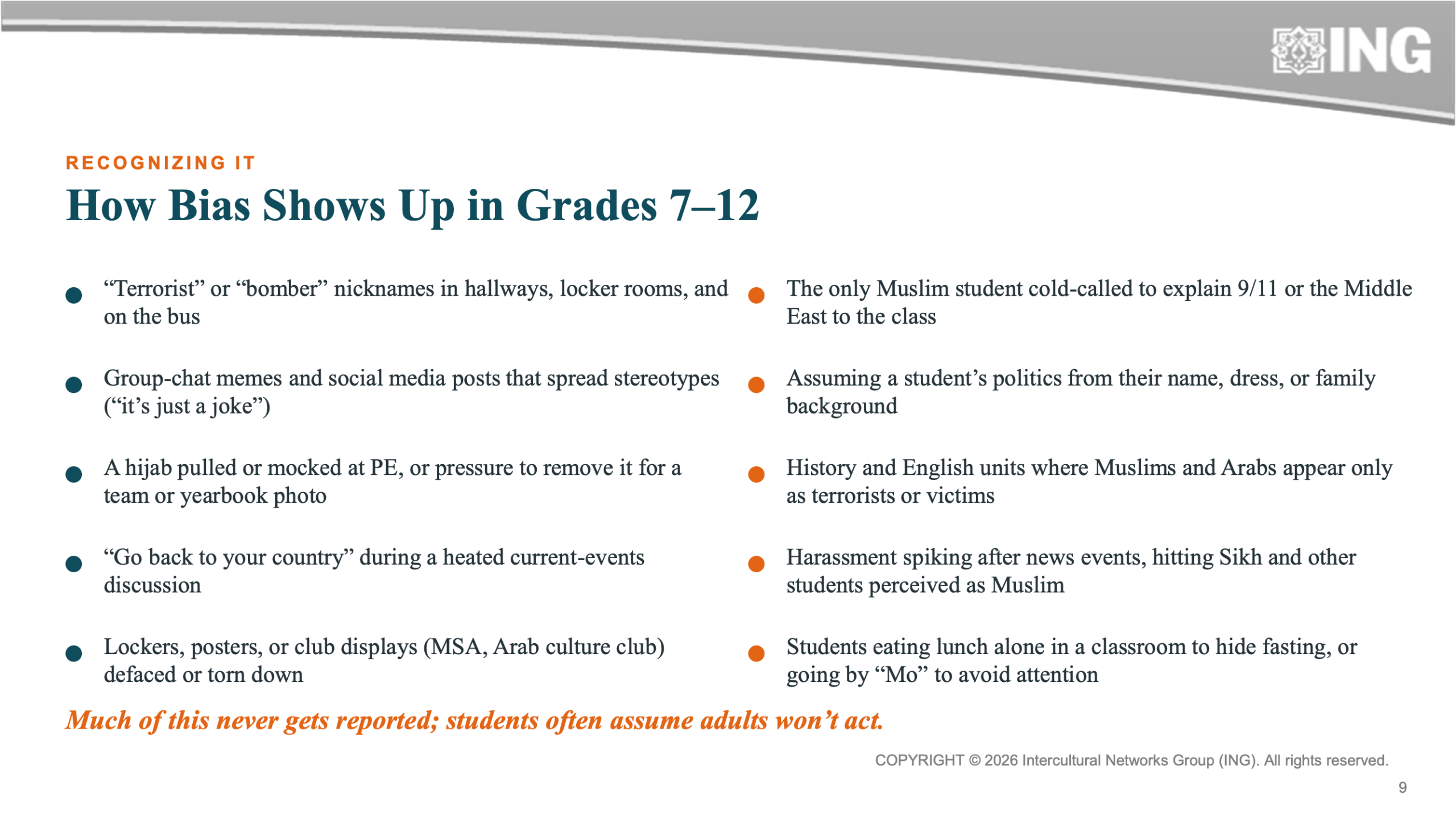
This slide makes the bias concrete for middle and high schools. It sounds like ‘terrorist’ or ‘bomber’ nicknames in hallways, locker rooms, and on the bus. It spreads through group-chat memes and social media posts that students defend with ‘it’s just a joke.’ It looks like a hijab pulled or mocked at PE, or pressure to remove it for a team or yearbook photo. It erupts as ‘go back to your country’ during a heated current-events discussion, and it shows up as defaced lockers or a torn-down Muslim Student Association (MSA) poster. Sometimes it comes from well-meaning adults, like cold-calling the only Muslim student to explain 9/11 or the Middle East to the class. And notice what students do to stay invisible: eating lunch alone in a classroom to hide that they are fasting or going by ‘Mo’ instead of Muhammad. Most of this never gets reported, because teens assume adults will not act. Educators cannot wait for reports; they have to watch for it.
Slide 10 — The Guiding Principle
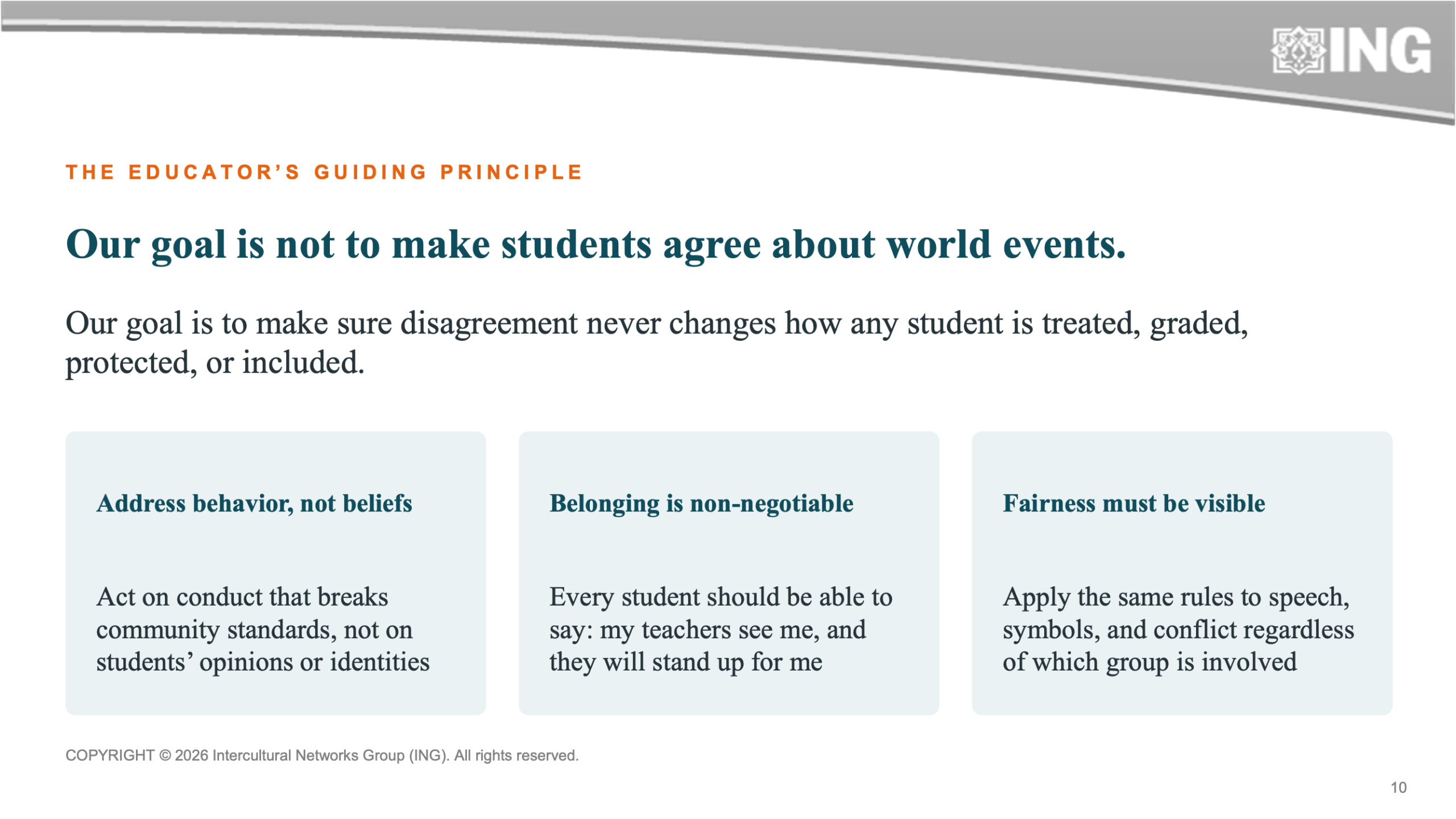
Before turning to strategies, this slide states the principle that makes all of them workable. The goal of a school is not to make students agree about world events; that is not an educator’s job, and it is not possible. The goal is to make sure disagreement never changes how any student is treated, graded, protected, or included. Three commitments follow. Address behavior, not beliefs: act on conduct that breaks community standards, not on opinions. Belonging is non-negotiable: every student should know their teachers will stand up for them. And fairness must be visible: the same rules apply to speech, symbols, and conflict no matter which group is involved.
Slide 11 — Strategy 1: Use Inclusive Language
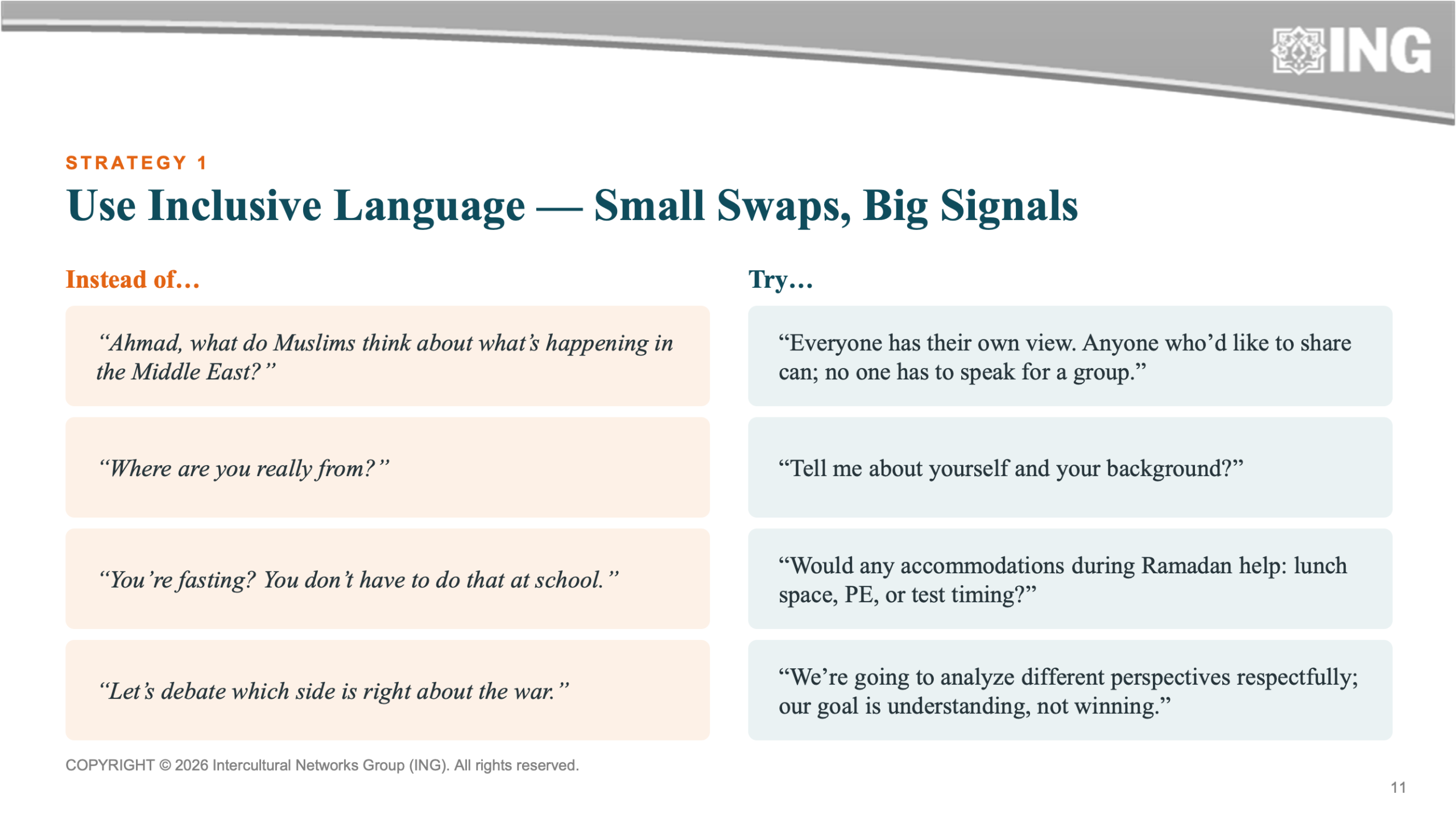
The first strategy costs nothing and can start right away: small language swaps, drawn from real secondary classrooms. The biggest one: never cold-call a student as a spokesperson for a group. Instead of ‘Ahmad, what do Muslims think about what’s happening in the Middle East?’ the slide suggests ‘Everyone has their own view. Anyone who’d like to share can; no one has to speak for a group.’ Instead of ‘Where are you really from?’ try ‘Tell me about yourself and your background?’ When a student is fasting, the goal is not to talk them out of their practice; instead of ‘You don’t have to do that at school,’ try ‘Would any accommodations during Ramadan help, such as lunch space, PE, or test timing?’ And when a hot topic arises in social studies or English, rather than staging a debate with a winner, frame it as: ‘We’re going to analyze different perspectives respectfully; our goal is understanding, not winning.’
Slide 12 — Strategy 2: Support Religious Practice
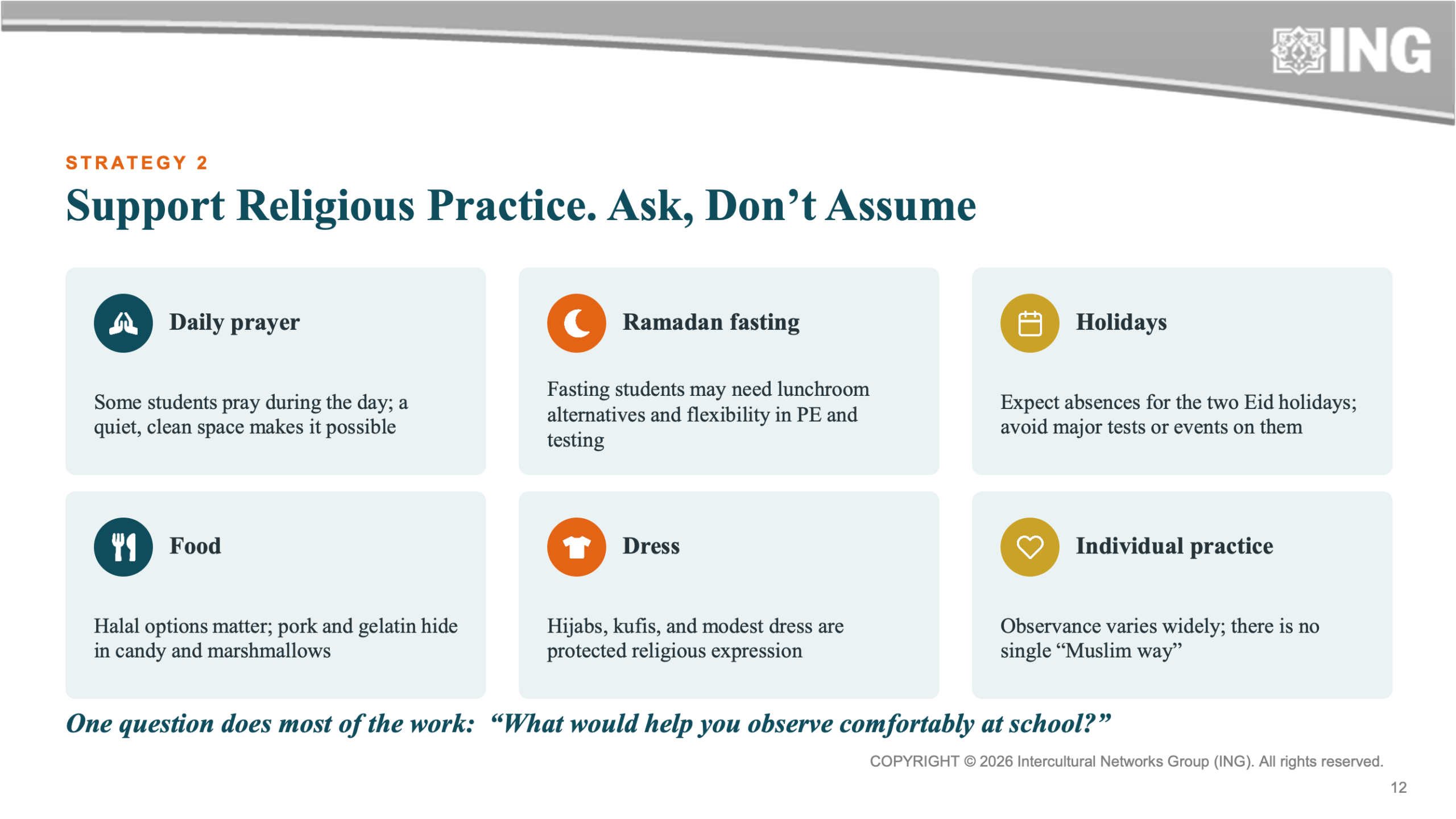
The second strategy is planning for religious practice so that students never have to choose between their faith and fitting in. Some students pray during the day; a quiet, clean space makes that possible. During Ramadan, fasting students may need somewhere to be besides the cafeteria, along with some flexibility around PE, testing, and after-school events. Schools should expect absences on the two Eid holidays and avoid scheduling major tests on them. Halal food matters, and pork and gelatin hide in unexpected places like candy and marshmallows. Hijabs, kufis, and modest dress are protected religious expression, not dress-code problems. And observance varies enormously by family and individual; there is no single ‘Muslim way.’ As the bottom of the slide says, one question does most of the work: ‘What would help you observe comfortably at school?’
Slide 13 — Strategy 3: Interrupt Bias in the Moment
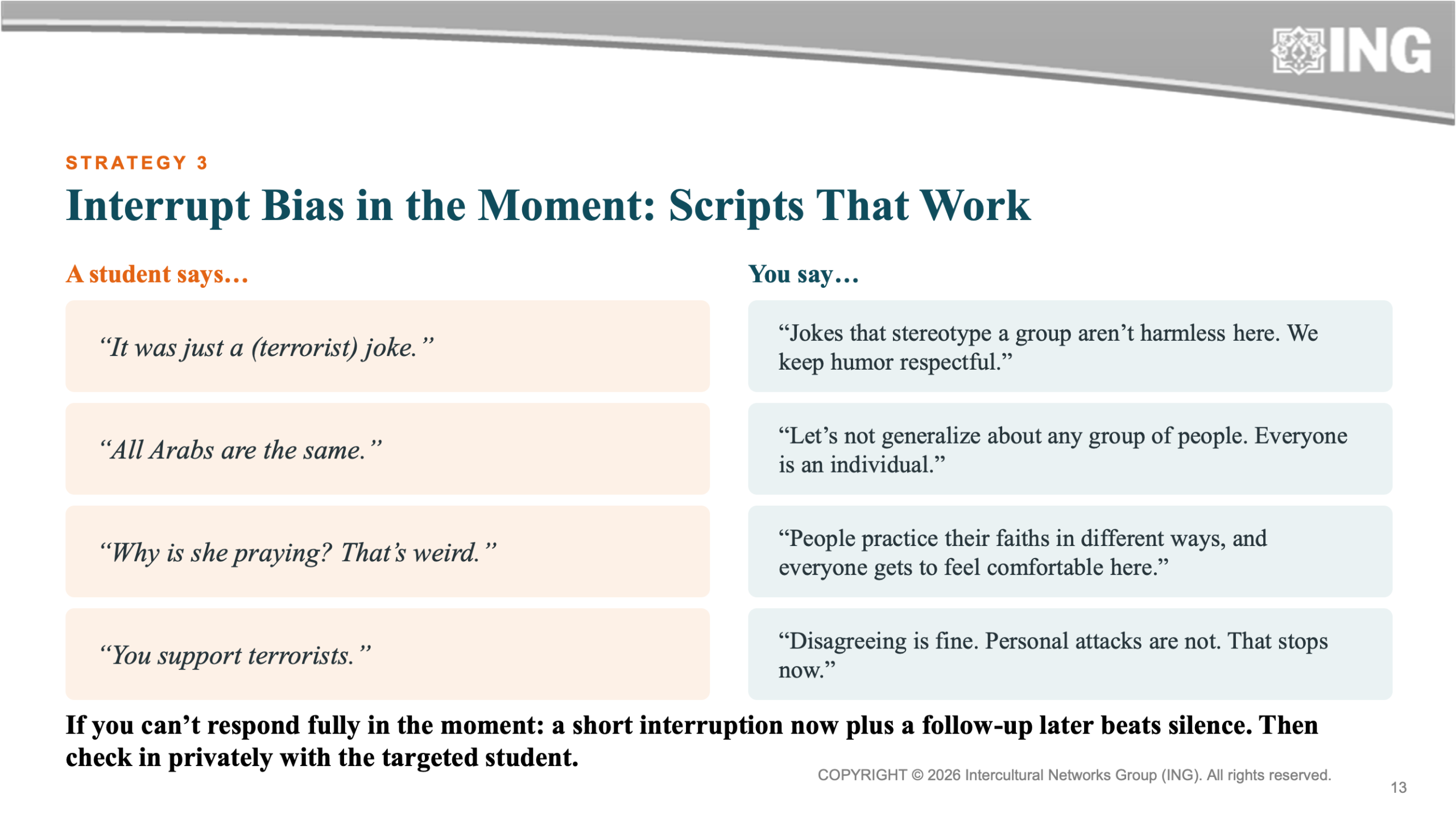
The third strategy is the hardest and the most important: saying something in the moment. When an adult stays silent, students read it as permission. The slide offers four scripts; they are short on purpose, so they are easy to remember. For a ‘joke,’ name the impact: ‘Jokes that stereotype a group aren’t harmless here.’ For a generalization: ‘Let’s not generalize about any group. Everyone is an individual.’ When a student mocks prayer: ‘People practice their faiths in different ways, and everyone gets to feel comfortable here.’ For a personal attack: ‘Disagreeing is fine. Personal attacks are not. That stops now.’ And for the moments when the right words do not come, which happens to everyone, a short interruption now plus a follow-up later beats silence. Then check in privately with the student who was targeted.
Slide 14 — Strategy 4: Know the Line, and When to Bring in Others
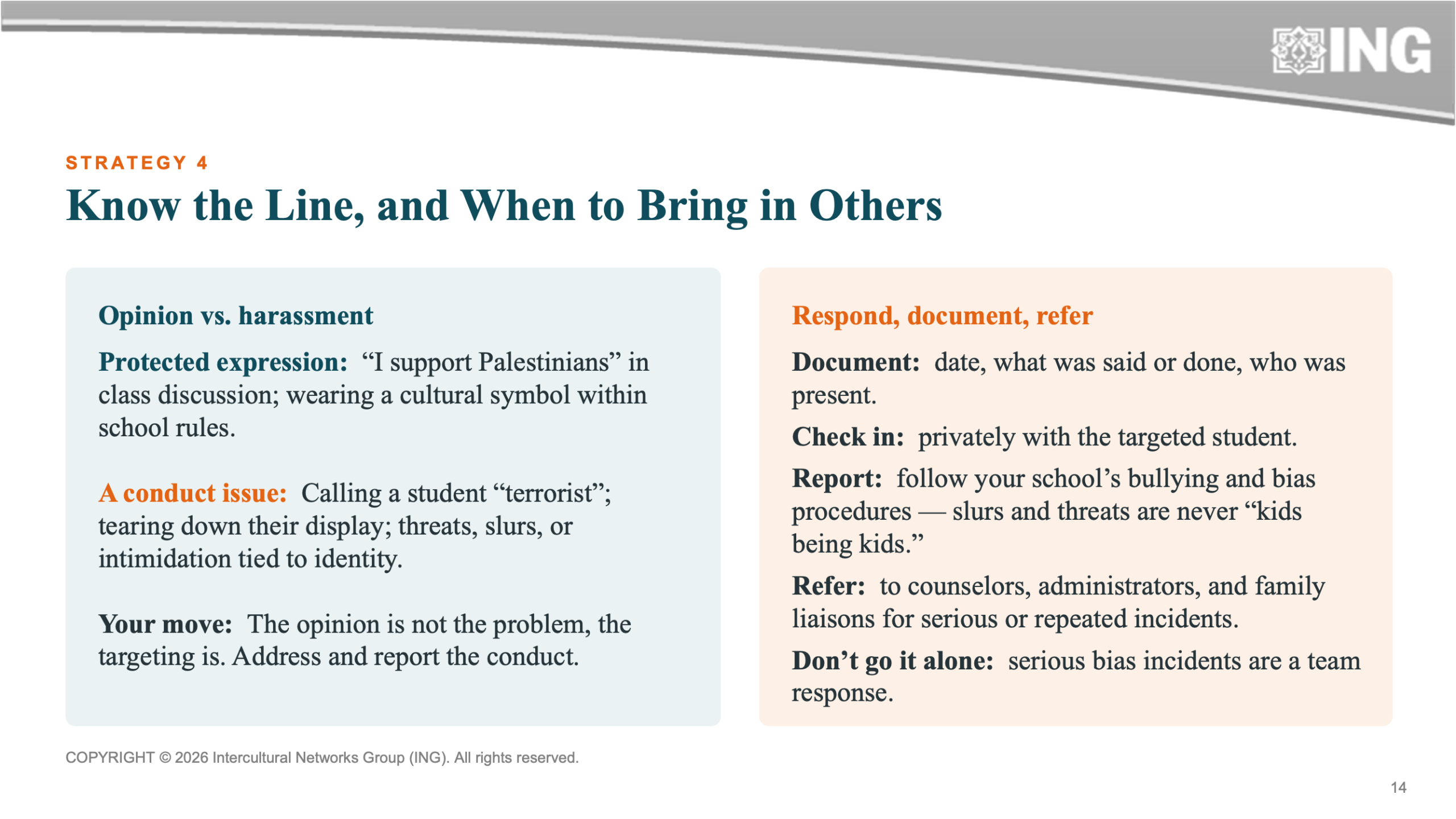
The fourth strategy is knowing where the line is. A student saying ‘I support Palestinians’ in a class discussion is protected expression. A student following a classmate around calling them ‘terrorist,’ tearing down their display, or threatening them over their identity is a conduct issue, full stop. The opinion is never the problem; the targeting is. The right panel lays out the response chain: document the date, the words, and the witnesses. Check in privately with the targeted student. Report through the school’s bullying and bias procedures; slurs and threats are never ‘kids being kids.’ Refer serious or repeated incidents to counselors and administrators. And no educator should carry a serious bias incident alone; it is a team response.
Slide 15 — Closing: Every Student Belongs
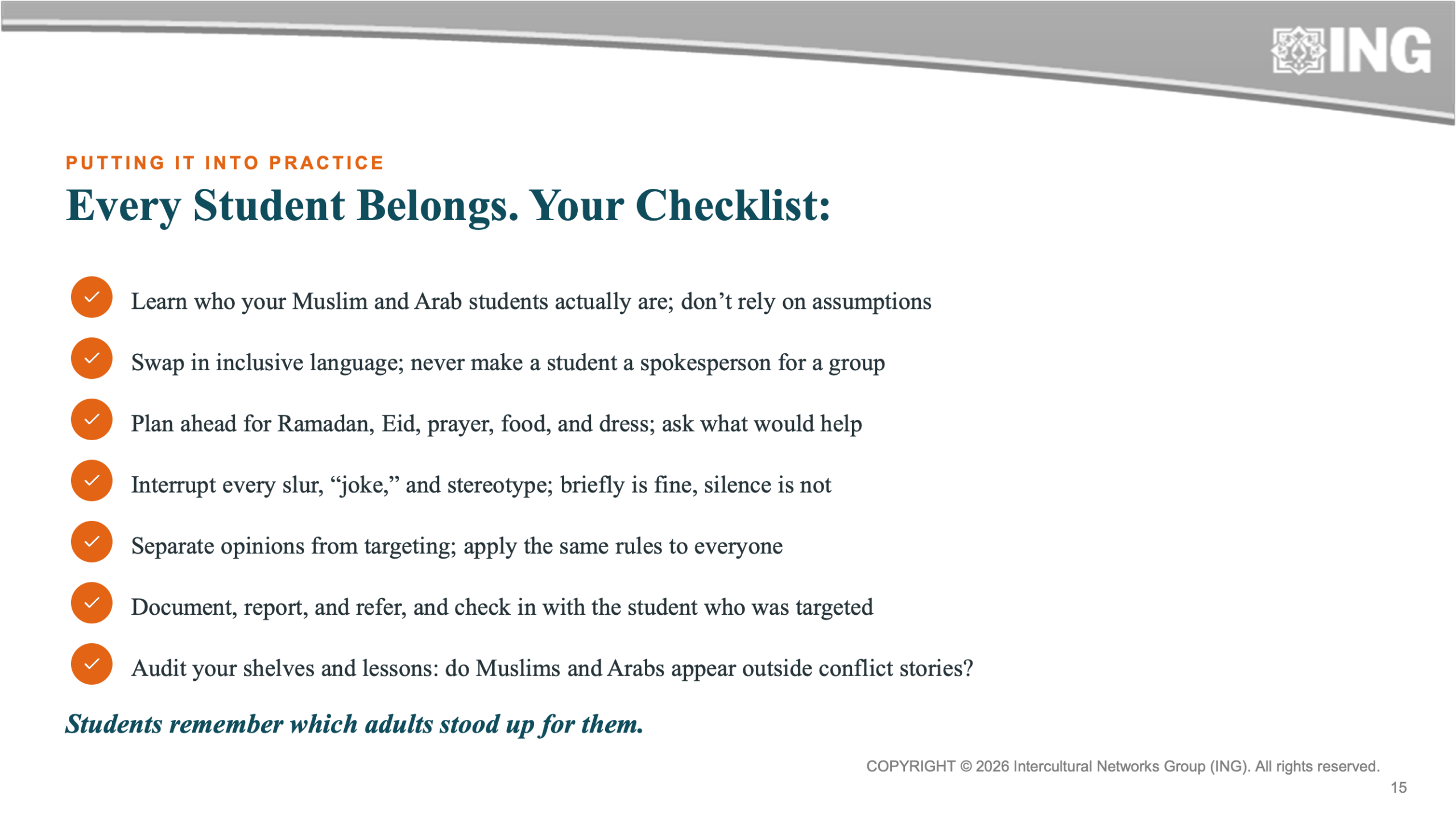
The presentation closes with a checklist: commitments, not suggestions. Learn who your Muslim and Arab students actually are. Swap in inclusive language and never make a student a spokesperson. Plan ahead for Ramadan, Eid, prayer, food, and dress. Interrupt every slur, joke, and stereotype; briefly is fine, silence is not. Separate opinions from targeting and apply the same rules to everyone. Document, report, refer, and check in with the student who was hurt. Take one look at your shelves and lessons: do Muslims and Arabs ever appear outside of conflict stories? We encourage you to pick one item from this list to try this week. Years from now, students will not remember every lesson they were taught, but they will remember which adults stood up for them.
Slide 16 — Go Deeper with ING’s Educator Trainings
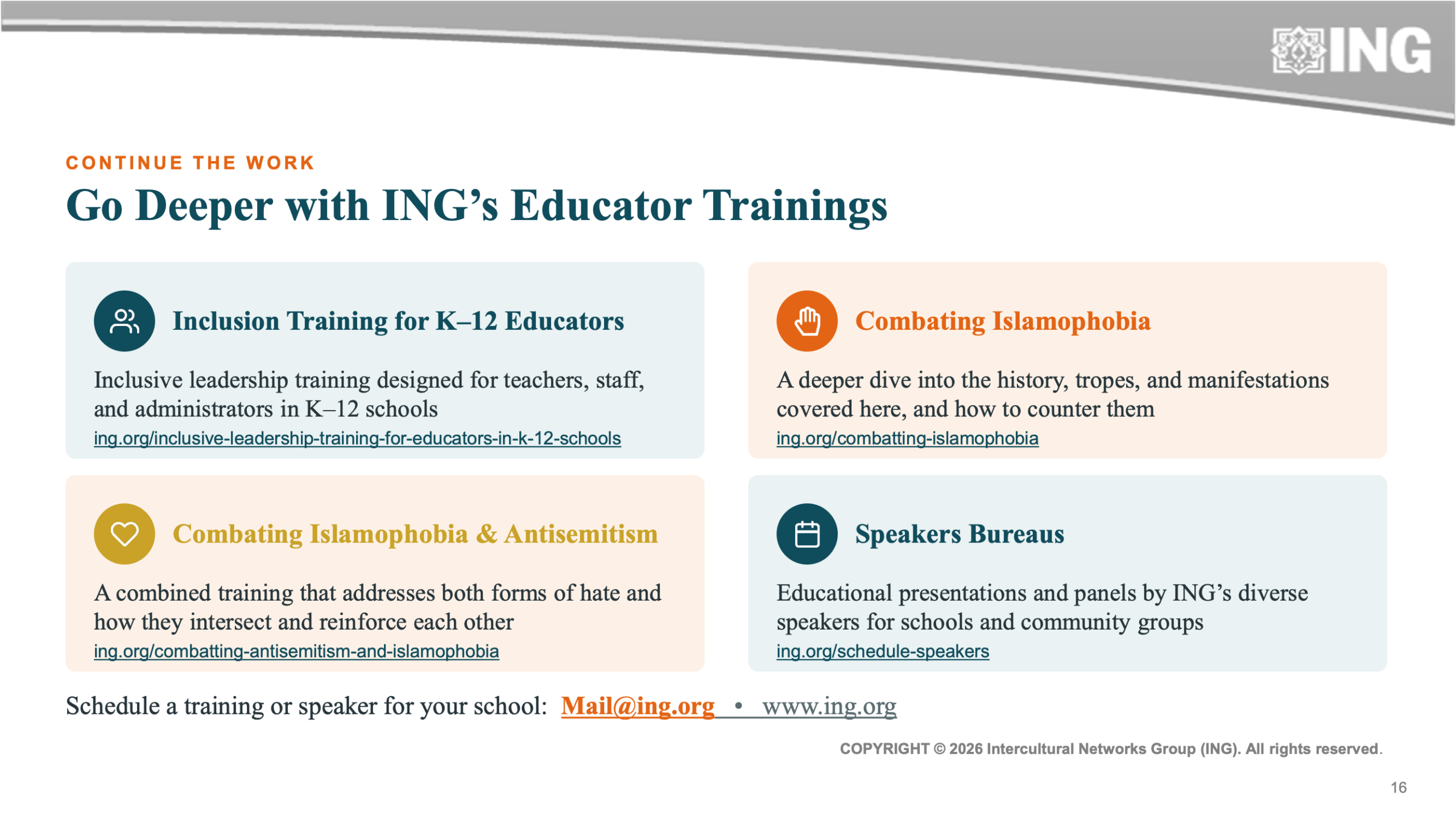
If this presentation sparked something, it is just the starting point; ING offers much more. For your whole staff, our Inclusion Training for K–12 Educators is an inclusive leadership program built for teachers, staff, and administrators. To go deeper on this topic, our full Combating Islamophobia training expands on everything covered here. We also offer a combined Combating Islamophobia and Antisemitism training that addresses both forms of hate and how they intersect and reinforce each other. And through our Speakers Bureaus, you can bring diverse ING speakers to your school for educational presentations and panels for students, staff, or community groups. All four programs appear on the slide with their links. To schedule a training or a speaker, contact us at Mail@ing.org. Thank you for viewing, and for everything you do for your students.
