
Sign up for the ING newsletter to receive news and announcements.
Dear Friends,
Now that the midterm elections are behind us, it is worth reflecting on the contrasting ways religion featured in this campaign season.
While many candidates openly embraced their faith as a source of inspiration and a guiding force in their public service, others found their faith and heritage weaponized against them, often by political opponents, including some holding federal office. Rather than engaging with their ideas and policies, these attacks sought to cast doubt on their character, loyalty, and fitness for office simply because of who they are and what they believe.
In Michigan, the Muslim nominee for U.S. Senate was called a “jihadist” who would have to “go through a metal detector” to enter the Senate. In Kansas, the faith of the Democratic Senate nominee, a United Methodist pastor, was publicly questioned. In Pennsylvania, a man was charged with threatening to burn down the home of the governor, who is Jewish and was running for reelection, and Jewish members of Congress from both parties reported antisemitic voicemails and death threats. In Ohio, the Republican nominee for governor, who is Hindu, was mocked for his faith and Indian heritage by a rival in his own party. And in Texas, a state official said the Democratic Senate nominee, a Christian trained at a Presbyterian seminary, would “go to hell” for how he reads the Bible.
Whatever our politics and whatever the results, these attacks tell young people that some Americans belong less than others. Our classrooms are one of the best places to question and answer that message.
That is why we are pleased to announce a new series of free lesson plans for educators and community leaders. Students usually study world religions as ancient history: where each faith began and what it teaches. They rarely learn how Muslim, Jewish, Buddhist, Hindu, and Christian communities took root in America, how they were sometimes excluded, how they claimed the Constitution’s promise of religious freedom, and what they have contributed to the country we share. These plans fill that gap:
- Here Since the Beginning (Muslim Americans)
- To Bigotry No Sanction (Jewish Americans)
- Dharma Across the Pacific (Buddhist Americans)
- The Temple Down the Road (Hindu Americans)
- One Faith, Many Peoples (Christian Americans)
Each plan includes primary sources, a student source packet, a teacher key, and an assessment for middle and high school classrooms in any state. Each can also be paired with an ING speaker panel, in person or virtual.
For educators: Download the plans for free at Religion in America: Lesson Plans on Five Faith Communities and schedule a speaker panel at ing.org/schedule-speakers.
For community organizations: Please share these plans with the teachers, schools, and districts in your area, or use them in your own programs.
Coming before the end of the year: units on how stereotypes about different American communities were formed and how to challenge them, and new lesson plans on Asian Americans, Black Americans, Hispanic and Latino Americans, and Indigenous Peoples.
With gratitude,
Maha Elgenaidi
Executive Director
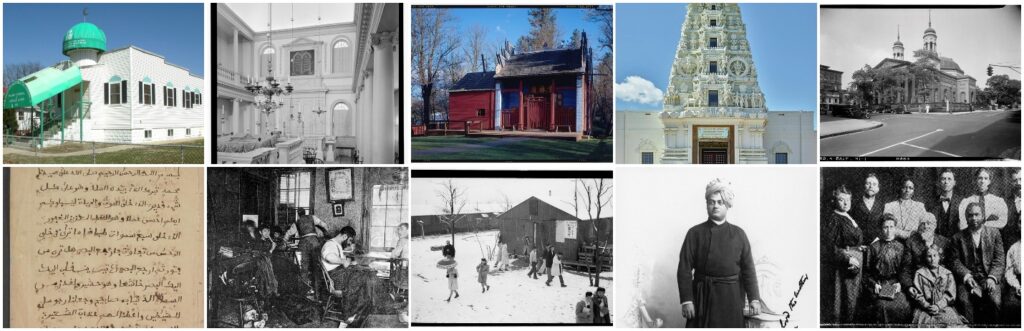
About the image above, drawn from the five lesson plans:
Five faiths, one American story. Top row, left to right: the Mother Mosque of America, Cedar Rapids, Iowa (1934); Touro Synagogue, Newport, Rhode Island (1763); the Weaverville Joss House, California (1874); the Hindu Temple and Cultural Center of Iowa; and the Basilica of the Assumption, Baltimore (begun 1806). Bottom row: Omar ibn Said’s Arabic autobiography, North Carolina (1831); a Lower East Side garment workshop, New York (about 1890); a Buddhist service at the Manzanar incarceration camp, California (1943); Swami Vivekananda in Chicago (1893); and leaders of the Azusa Street Mission, Los Angeles (1907).
Image credits: Mother Mosque: RifeIdeas, CC BY-SA 3.0, via Wikimedia Commons (cropped). Touro Synagogue, Basilica of the Assumption, and Weaverville Joss House: Historic American Buildings Survey, Library of Congress. Hindu Temple: Carol M. Highsmith, Library of Congress. Omar ibn Said: Library of Congress, Omar Ibn Said Collection. Lower East Side: Jacob A. Riis, How the Other Half Lives (1890). Manzanar: Ansel Adams, Library of Congress. Vivekananda: Thomas Harrison, 1893. Azusa Street: courtesy of the Flower Pentecostal Heritage Center (iFPHC.org).